
The challenges of artificial intelligence and platformization for the Spanish banking sector
Spanish banks remain ahead of their European peers in AI adoption, although the gap is narrowing, and continue to favour in-house technological development. Meanwhile, the growing integration of banking services into third-party digital platforms is creating new opportunities while raising questions about banks’ control over distribution channels and customer relationships.
Abstract: The Spanish banking sector remains among Europe’s leading adopters of artificial intelligence (AI), although its relative advantage is narrowing. Drawing on the annual reports of the ten largest Spanish banks, a composite indicator shows an increase in AI adoption at nine institutions between 2021 and 2025, with several institutions doubling or tripling their scores. Spain’s overall adoption level stands 37.9% above the European average, ahead of Germany, France, Italy and the United Kingdom. However, adoption grew more slowly in Spain (83.5%) than across Europe (122.8%), as countries starting from lower levels accelerated. Spanish banks continue to favour developing AI capabilities internally, with in-house development accounting for 51% of adoption strategies, compared with 35% for licensed solutions and 14% for strategic alliances. In parallel, the integration of banking services into digital platforms is advancing, with 270 APIs available through 36 developer portals and access increasingly concentrated among specialised aggregators. Payments and account access account for the majority of these interfaces, highlighting both the opportunities offered by digital ecosystems and the challenges banks face in maintaining control over distribution channels and customer relationships.
AI in the banking sector
Artificial intelligence (AI) plays an increasingly important role in the transformation of economic and financial activity, with particular implications for the banking sector. Financial institutions are incorporating these technologies in various areas, such as customer service, service personalization, credit scoring, fraud detection, and the automation of internal processes. The expansion of these applications undoubtedly reflects the potential of AI-based tools to transform banking operations, the delivery of financial services, and decision-making processes.
The opportunities associated with these technologies, however, coexist with challenges related to data availability and quality, the reliability and explainability of models, data protection, and compliance with regulatory requirements. In this context, the extent to which these technologies are incorporated into routine banking activities will depend not only on the benefits that institutions identify in their potential applications, but also on how they assess the associated risks, as well as the decisions they make regarding the integration of these AI-based solutions. The adoption of AI raises strategic decisions regarding how to access these technologies and develop the necessary capabilities for their use, whether through the acquisition of third-party solutions via licensing, the establishment of strategic partnerships, or in-house development.
At the same time, the technological transformation currently shaping the banking sector is also changing the way banks interact with and reach their customers through digital channels. In this context, “platformization”—understood as the use of digital platforms to provide financial services and interact with customers—constitutes another significant dimension of the technological changes the sector is currently facing.
The objective of this article is to analyze the degree of AI adoption in the Spanish banking sector and its main areas of application. It will also examine the strategies used by banks to incorporate these technologies, distinguishing between the acquisition of licenses, the establishment of strategic alliances, and in-house development. Finally, the article will examine the Spanish banking sector’s position in the process of platformization, focusing on the role of digital platforms in the distribution and provision of financial services, as well as its position in terms of access channels and customer relationships.
The adoption of AI in Spanish bankingThe extent to which AI has been incorporated into banking activities is currently one of the most relevant factors for understanding the technological transformation of the banking sector and allows for an analysis of how banks are evolving in this area. However, obtaining detailed information on the strategies and methods through which banks are incorporating these tools—as well as the applications in which they are being adopted—poses a challenge. In the recent Funcas study on the adoption of AI and the platformization of the Spanish banking sector (Cuadros-Solas et al., 2026), a detailed analysis is presented on the evolution of the degree and strategies of AI adoption by the Spanish banking sector, its applications, and the potential effects of integrating AI into banking activities. To this end, a composite indicator has been calculated that integrates various dimensions related to its application. Specifically, to calculate this metric, a conversational AI was used and asked to quantify—on a scale from 0 (no use) to 10 (very widespread use)—the extent to which banks are using AI-based tools. The main input for the calculation is the information provided by the ten leading Spanish banks in their annual reports
[1]. Specifically, this indicator—calculated for the 2021–2025 period—considers aspects related to operational support, product personalization and recommendations, process automation, subscription and
onboarding systems, fraud detection, credit assessment models, and investment portfolio management. The score obtained thus provides an indication of the level of AI implementation at the institutions analyzed.
Exhibit 1 presents a comparison between 2021 and 2025 regarding the degree of AI adoption by the ten Spanish banks examined.
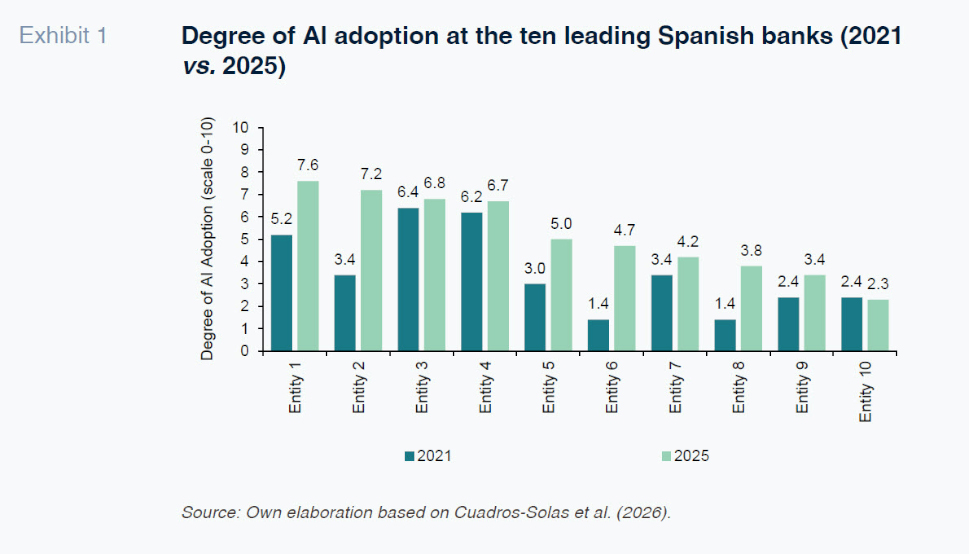
In light of the data, it can be stated that, between 2021 and 2025, the rate of AI adoption increased significantly at nine of the ten banks analyzed, although there were significant differences both in the levels achieved and in the pace of progress. During the period analyzed, the average growth rate stood at 70.7%, although significant differences were observed among institutions, with some having doubled or even tripled their level of adoption of this technology. This trend points, in any case, to a gradual incorporation of these tools into the Spanish banking sector, although their development has not been uniform across institutions. While some banks were already operating at relatively high levels in 2021 and have consolidated their position in recent periods, others have made more pronounced progress throughout the entire period under review, having started from a relatively lower baseline.
The technological transformation currently shaping the Spanish banking sector is part of a broader trend toward digitalization affecting the entire banking sector in Europe. This trend is reflected in the degree of adoption these tools have achieved across Europe. According to the EBA, most banks in the European Union were already using AI solutions by 2024, while a significant portion of these initiatives had moved beyond the experimental phase and been integrated into the banks’ technological infrastructures (EBA, 2024). Likewise, the ECB notes that, in 2025, nearly 90% of significant banks in the euro area were already using AI-based technologies, against a backdrop of growing investment in digital technologies (ECB, 2026). This scenario justifies the interest in analyzing the evolution of AI adoption in the Spanish banking sector from a comparative perspective, in order to assess its relative position
vis-à-vis the European banking sector as a whole. To this end, Exhibit 2 presents a Europe-wide comparison of AI adoption during the 2021–2025 period.
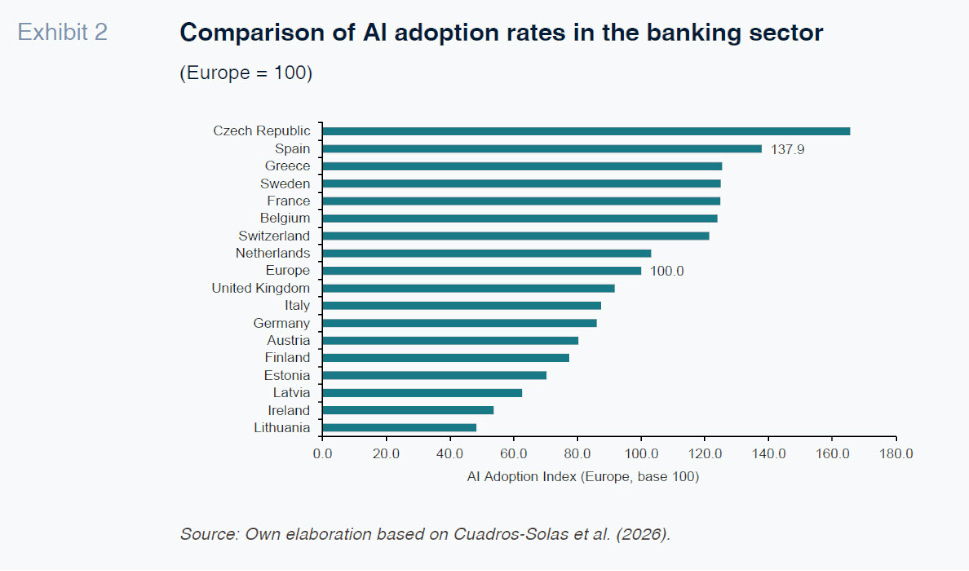
Following the methodology outlined above, an index is calculated for each country, using the average level of AI adoption in Europe during the 2021–2025 period as a benchmark (Europe represents the base of 100). Based on this benchmark, the degree of adoption in each country is analyzed relative to the European average. All countries with values above 100 indicate that their banking sector makes more intensive use of AI than the overall average for European banking.
As can be seen, Spain ranks among the European countries with the highest level of AI adoption in the banking sector, with a level 37.9% higher than the European average. The Spanish banking sector outperforms other economies that also have relatively high adoption levels, such as Greece, Sweden, France, and Belgium. The differences are even more pronounced compared to some of the major European economies, such as Germany, Italy, and the United Kingdom, whose adoption levels fall below the European average.
However, this leading position of the Spanish banking sector contrasts with the faster growth rate recorded across Europe as a whole in recent years. Between 2021 and 2025, AI adoption in the Spanish banking sector increased by 83.5%, compared to the 122.8% growth observed across Europe as a whole. These results indicate that, although the Spanish banking sector maintains a leading position in the adoption of this technology, the gap relative to the European average has been gradually narrowing as a result of the faster pace of expansion in other European countries.
In particular, the higher growth recorded for European banking in recent years is not so much due to a slowdown in the adoption process within Spanish banking, but rather to a more pronounced acceleration across the European banking sector as a whole, which started from lower average adoption levels.
AI adoption strategies in Spanish banking
Beyond the degree of AI adoption, it is important to analyze the various ways in which banks incorporate these technologies into their operations. In particular, banks may choose to develop solutions in-house, acquire tools and licenses from external technology providers, and/or form strategic alliances with specialized companies. These alternatives correspond to different models for accessing technological capabilities and have distinct implications in terms of investment, control over the implemented solutions, access to specialized knowledge, and dependence on third parties. Therefore, examining the chosen strategies provides deeper insight into how the banking sector is integrating AI into its operational processes and structures, beyond simply the degree of adoption.
Based on information gathered from annual reports, Exhibit 3 shows the distribution of AI adoption strategies among the ten Spanish banks analyzed. The results reveal a clear predominance of in-house solution development, which accounts for 51% of the identified strategies. This is followed by the acquisition of licenses from external providers, at 35%, while strategic alliances account for the remaining 14%.
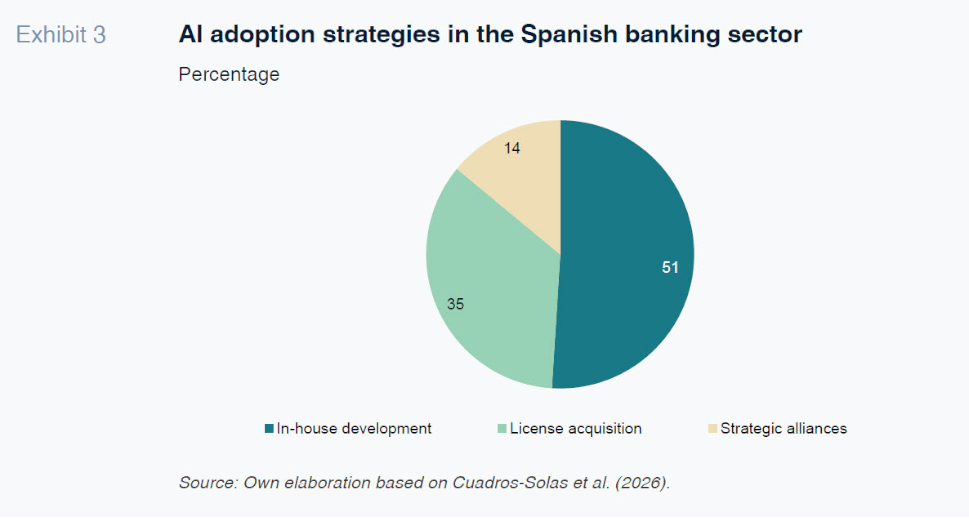
The prominence of in-house development highlights the importance banks place on building their own capabilities to integrate AI into their processes and services. This strategy can facilitate better adaptation of solutions to the specific business needs of each bank and greater control over their development and implementation, although it requires specialized talent, technological resources, and sufficient investment capacity. On the other hand, acquiring licenses provides access to already-developed technologies and speeds up their implementation, although it may lead to greater dependence on external suppliers. Strategic alliances, meanwhile, offer a way to combine the capabilities and expertise of different organizations, although their lower share in the analyzed distribution suggests that this approach to integrating AI is currently less widespread.
The combination of these different strategies therefore appears to address the need to balance adapting technology to business needs with the speed of implementation and access to specialized expertise. These decisions take on particular significance in a sector where information security, risk management, and regulatory requirements influence both the selection of solutions and their integration into banking operations.
Platformization of Spanish banking
The digital transformation of the banking sector is changing not only the way financial services are provided but also the channels through which banks reach their customers and distribute their products. In this context, platformization is becoming increasingly important, as it reflects the integration of banking services into digital ecosystems involving not only the banks themselves but also technology providers and other intermediaries. One of the elements facilitating this process is the development of application programming interfaces (APIs), which enable banking systems to connect with external platforms and services, promoting interoperability and the integration of financial functionalities across different digital environments.
From a strategic perspective, platformization can transform the way banks distribute their products, interact with users, and compete with other players in the financial market. Consequently, analyzing the development of API infrastructure provides deeper insight into the position of Spanish banks within digital financial ecosystems. In this regard, the study on the Spanish banking sector notes that banks operating in Spain offer 270 APIs and maintain 36 API developer portals, through which third parties can consult technical documentation and access the available interfaces. Furthermore, 79.6% of the identified APIs are available through specialized aggregators, highlighting the role of these intermediaries in connecting banks with potential users of their digital services.
This intermediation also exhibits a significant degree of concentration. In fact, 75% of the APIs accessible through aggregators are channeled through the five leading operators. This data highlights the importance of a small number of intermediaries in shaping the digital banking ecosystem. From the perspective of financial institutions, using these platforms can facilitate the integration of their services into new channels and expand their commercial reach. However, it can also increase dependence on third parties and raise issues related to control over distribution channels, access to customers, and the bargaining power of the various participants.
Exhibit 4 shows the distribution of the main uses of banking APIs in Spain. The results reveal a clear predominance of payment services, which account for approximately 55% of the total, followed by account access, at nearly 23%, and identity services, which exceed 10%. The remaining identified functionalities—including credit services, data access, commerce-related applications, and other services—account for a significantly smaller share.
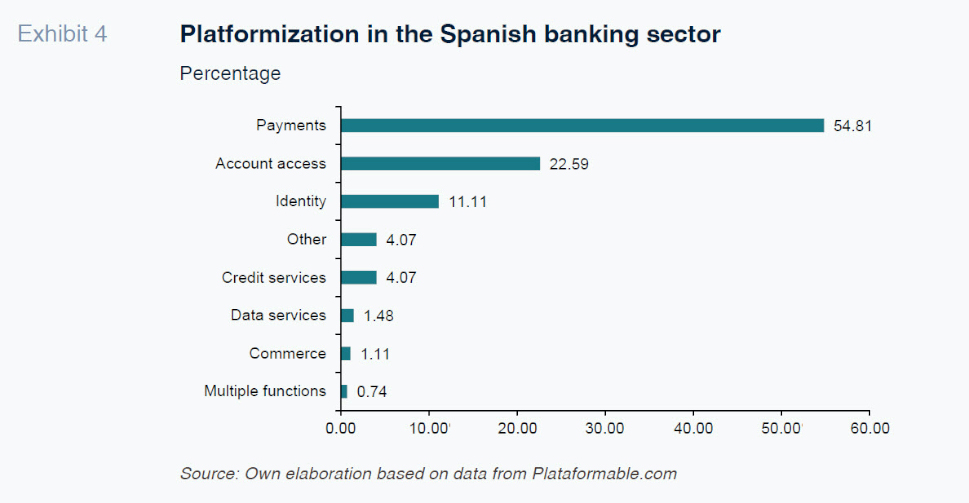
This reality highlights the central role of payments in the integration of banking services into digital ecosystems, as well as the importance of account access in facilitating the connection between financial institutions and external providers. For their part, identity services help incorporate identification, verification, and authentication functionalities into various digital environments. The concentration of APIs in these categories suggests that, at present, the platformization of the Spanish banking sector appears to revolve primarily around transactional services and mechanisms for account access and digital identification, while other applications maintain, for the time being, a more limited presence.
More evidence, but even more questions
The digital transformation of the Spanish banking sector is evident both in the growing incorporation of AI into banks’ operations and in the evolution of the channels and infrastructures through which financial services are provided. The evidence reveals significant progress in both areas. However, addressing this technological challenge requires the Spanish banking sector to strategically reflect on several issues:
- In which areas should the use of AI be prioritized? One of the main characteristics of this technology is its versatility, as it can be applied to numerous banking processes and services, such as customer service, the personalization of products and services, credit risk assessment, fraud detection, and the automation of internal processes. In this context, banks must identify the areas where AI can generate the greatest added value and prioritize its implementation based on the expected benefits. Furthermore, given that the success of its adoption also depends on customer acceptance, it is essential to assess customers’ willingness to use new products and services based on this technology. To this end, transparency and building trust must be central elements of AI adoption strategies in the banking sector.
- How to establish partnerships with external AI providers? Although the Spanish banking sector largely relies on in-house development of AI solutions, the rapid advancement and growing complexity of this technology may make it necessary to turn to specialized external providers. As new applications and needs arise, institutions’ internal capabilities may prove insufficient, underscoring the importance of establishing strategic alliances. In this context, one of the main medium-term challenges will be identifying reliable technology providers capable of integrating their solutions into banks’ value chains without compromising their security and operational resilience. Likewise, it will be essential to properly manage the risks associated with reliance on third parties and ensure that these partnerships help strengthen banks’ competitiveness and capacity for innovation.
- How can institutions capitalize on the opportunities of platformization without losing control over customer relationships? The growing integration of banking services into digital platforms and ecosystems offers new opportunities to expand distribution channels, improve customer experience, and develop new business models. However, it also poses challenges related to dependence on technology intermediaries, market concentration, and the potential loss of control over customer relationships. In this context, financial institutions must define platformization strategies that allow them to reap the benefits of collaboration with third parties while preserving their strategic autonomy, competitive capacity, and operational resilience.
The process of technological transformation currently underway in the banking sector depends not only on the expansion of new technologies but also on strategic decisions regarding how to incorporate them and on the ability to integrate them into financial service delivery channels. In this context, the development of in-house technological capabilities, the management of risks associated with AI, and the exploitation of opportunities offered by digital platforms will be key factors in the evolution of the banking business model.
Notes
The methodological appendix of Cuadros-Solas et al. (2026) describes in detail the process for calculating the indicator and provides the prompt used.
References
Pedro Cuadros-Solas. CUNEF University and Funcas
Francisco Rodríguez. University of Granada and Funcas
Nuria Suárez. Autonomous University of Madrid and Funcas